When Chris and Stephanie Hallowich built
their family’s new home on 10 pristine acres in Mount Pleasant
Township near Hickory Pa, there wasn’t much Marcellus production
activity close by. Over the next few years, several gas wells, a
large impoundment dam, a cryogenic gas processing facility and a
compressor station were all constructed within several thousand feet
of their home.
Stephanie's family home in Hickory below their new
neighbor,
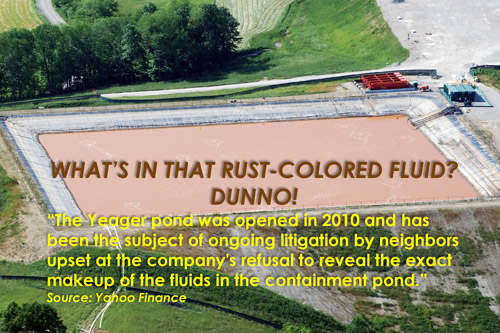
a huge impoundment dam holding recycled frac fluids.
The impoundment dam went from holding fresh
water to flowback, and holes developed in the plastic liner. Results
from water tests on their well water began showing bizarre chemicals
like acrylonitrile, as well as toluene, ethyl benzene, tetra-chlorethylene
and styrene.
Patch on one of the holes in the frac pit liner
They found out one of the chemicals is incredibly
dangerous to breathe in when showering, even more so than from dermal
contact or ingesting it. Since the Pennsylvania DEP doesn’t test
well water for any volatile organic compounds, they weren’t
much help to the Hallowich family.
As Stephanie put it, “People don’t know where to go,
people don’t know what to do. People call the DEP because they’ve
got water problems and the DEP tests for 14 things, and their
water’s black and oily, and the DEP says there’s nothing in it,
it’s safe to drink! Nobody’s testing for VOC’s and there are
hundreds of those that they’re using all over the country, all the
different companies, to frack with. Who are we supposed to go to?
The burden falls upon the landowner to pay for all this testing.”
See 1:48 mark of the video above
for a look at
Stephanie's backyard, in this interview with Larry Chome,
the Mt Pleasant Township
zoning officer.
Mr Chome tells how construction took
place without the proper permitting.
In the meantime, the cryogenic facility, which
was initially built without the proper local permits, began to
enlarge. Then the compressor station doubled in size from two
compressors to four. Soon the children were experiencing nose bleeds,
similar to what has been reported from residents of Dish, Texas,
another small area overpopulated with compressor stations.
Cryogenic facility in their backyard (Note the roof of Hallowich's house in center left of photo)
The Hallowich family also began to notice
how much better they felt when they were away from their “Gasland”
property for any extended period of time.
Stephanie Hallowich explains it this way, “We
have a gas plant and compressor station next door, and we’ve had a
lot of air issues, where it smells really bad, we get burning eyes,
burning throats, headaches, ringing ears; we don’t know what’s
coming out. We recently had some air testing done and it’s shown
that there are high levels of volatile organic compounds (VOC) coming out
of these plants. And with the compressor station and the plant being
so close together, and two completely different companies, they each
have their own air permit. First of all, they should never be
allowed that close together because the emissions are too extreme.
The DEP doesn’t look at the cumulative effect of these emissions
coming out so we’re getting kind of a double whammy of what would be
allowed anywhere else.”
Stewart compressor station following 2010 expansion
She continues, “When the man came to take the
air sampling tests, he didn’t even have the equipment completely out
of the car and the alarm went off for the VOC’s, and the alarms goes
off at 50 parts per million. We were above that, just in our
driveway. There was no odor that day, nothing that would give us a
clue that we were being exposed to that. That’s where my kids play,
their swing set is right next to that. That’s where they spend all
their time. We have a wind sock in the background because we watch
which way the wind blows so we know if anything is coming from the
plant or compressor. The levels are so high, and with what they have
breathed in, we don’t know what the long term effects are going to be.
Aly's Gasland
The only
logical choice for the Hallowich family was abandoning their new home
for the sake of their own health.
They aren’t the first Marcellus Shale
Refugees and surely won’t be the last.
Temporary water pipelines run from Cross Creek Lake
Pipes like these led to holes in the plastic pit liner
Water supply line
Gas well behind her house
Another gas well near her house
Construction of the dew point control facility in her "backyard"
Construction activities
Compressor
Initial construction of a second facility in her "backyard"
Stewart Compressor Station
Drilling activities out back
THE ACRYLONITRILE
"LINK"
When acrylonitrile turned up in Stephanie's well
water, people tried to "explain it away," coming up with
all kinds of reasons and excuses. None of them would
link the presence of acrylonitrile to Marcellus Shale
drilling. Some blamed the plastic rocks used as a
decorative mulch near the water well cover. The
manufacturer of those plastic rocks said it was
impossible. That turned Stephanie's focus to other water
wells in the Hickory area and marked the beginning of
her volunteer work to help others with water and air
quality problems near drilling.
With the help of volunteers at a professional lab in
the Pittsburgh area, Stephanie began to assist others
with professional testing of their well water. This was
particularly important since the Pennsylvania DEP does
not test for acrylonitrile or any volatile organic
compounds (VOC's).
In one set of test results, an alarmingly high level
of acrylonitrile was discovered in
Darrell Smitsky's well water. A pattern began to
emerge when acrylonitrile also turned up in nearly half
of all the water wells tested near Marcellus drilling
sites in the Hickory, Pennsylvania area.
It wasn't long before news came in from other states,
like
West Virginia and
Colorado, about acrylonitrile being present near gas
drilling and fracking operations. But perhaps most
alarming of all was its presence in Pittsburgh area
tapwater, at 11-times the level permitted in
Pennsylvania streams. Go figure, the frackers had been
dumping hundreds of thousands of gallons of drilling
wastewater into Pittsburgh rivers, with the source of
that particular drinking water being the
Monongahela River.
Speaking of streams... acrylonitrile was also
detected in the stream below the Hallowich's home, along
with reports of sick and dead cattle in a nearby field.
Have you tested your well water near gas drilling for
acrylonitrile yet?
December 5, 2011 Bible Camp flare on Agape Road can be seen to
the rear
left of the Hallowich's former house and Frac pit that
has been re-lined with a new black plastic liner