MARCELLUS
SITE MAP
Home
Terms of use
Contact us
Links
DRILLING
NEWS
Blogs
Hot issues
Gas Drilling News
Public Meetings
MARCELLUS AIR
PHOTOS
Aerial photographs of Marcellus Shale activities
Marcellus Shale drilling seen from the air
MARCELLUS
LEGISLATION
Drilling legislation
Engaged citizens
The FRAC Act
Halliburton loophole
POLITICAL
CONTRIBUTIONS
2009-2010
2007-2008
2004-2006
MARCELLUS
RIVERS
DRBC
ORSANCO
SRBC
MARCELLUS
WATER
ALL HAIL
Marcellus Shale
Beaver Run Reservoir
Blake Run Falls
Creeks & waterways
Cross Creek Lake
Dunkard Creek
Impoundments
Updated!
Monongahela River
Piping water
Wanted: Water
Water Management Plans for SW Pa.
WV Water Project
DRILLING WASTE & WASTEWATER
Brine truck photos
Clairton Municipal
Drilling wastewater
McKeesport Municipal
Updated!
Waste/ Wastewater Facilities 2010
Waste/ Wastewater
Facilities 2011
Wastewater facilities
MARCELLUS
ACCIDENTS
Atlas Frac Pit Fire
Gas well fires
Seeps, leaks, spills
Violations Tip Line
DRILLING
ISSUES
Intro to Marcellus
Air quality
Before you lease
Christmas Carols
Diesel idling - Act 124
Fracking near Schools
New!
Gas Drilling Wastewater
GASLAND movie
Jobs
Lessons learned
Marcellus documents
Pets and wastewater
Radioactive shale
New!
Road damage
Sick cattle
Updated!
Talking points
Trinity South
Truck traffic
FIRSTHAND EXPERIENCES
June Chappel
Jaime Frederick
New!
Terry Greenwood
Ron Gulla
Updated!
Stephanie Hallowich
Pam Judy
Kimberlie McEvoy
New!
Tim Ruggiero
Darrell Smitsky
Updated!
Crystal Stroud
Calvin Tillman
Updated!
Beth Voyles
YouTube
Updated!
GAS FACILITIES & EQUIPMENT
Compressor stations
Day Compressor Station
Frac truck photos
Fracking
Gas flares
Gas pipelines
Gas shale plays
Gathering pipelines
New!
Houston Pa. Gas Processing Plant
Lowry Compressor Station
Majorsville Gas Plant
Updated!
Marcellus FRAC
Marcellus pipeline
New!
Pennsylvania DEP
Photos of gas wells
Restored well sites
Seismic testing
Updated!
Welling Compressor Station
MARCELLUS
SHALE WELLS
MARCELLUS GAS PRODUCTION
NOW DRILLING
WEST VIRGINIA
Avolio Unit
Baker, Carol Unit
Bedillion-Day Unit
Bednarski Unit
Best Production Pad
Bigley Unit
Black, William Unit
New!
Chappel Unit
Costanzo Unit
Cowden 1H-2H
Cowden 3H-6H
Cross Creek Park
Day Unit
Drugmand Unit
Engel Unit
Foster Unit
Franklin Lakeview Estates
Godwin Unit
Goettel Unit
Harbison Unit
Hoskins Unit
Kearns Unit
LBROS Unit
Lowry Unit
Miller, John Unit
Miller, Lois Unit
Ohio Valley LBC
New!
Renz Well
Rodenski Unit
Rush, John Unit
New!
Sierzega Unit
Trax Farms
Troyer/Space Mgmt
Ward Unit
Weimer Unit
West, Eleanor
Worstell Unit
 

Our look at
BRINE AND WATER TANKER TRUCKS

  
If you know NOTHING ELSE about Marcellus Shale gas wells here is your 4-step Short Course on Marcellus wells and drilling wastewater..


1. Marcellus wells are very thirsty for water -- an average of 4 million gallons of water is needed per well, each time that well is 'fracked.'

2. Twenty to forty percent of that fluid comes back out of the abyss, with Mother Nature's contaminants added to the tens of thousands of gallons of chemicals that went down. These fluids need to be disposed of properly without endangering public health or the environment.

3. This "flowback" and "produced water" contains frac fluids and natural contaminants (often including NORM -- naturally occurring radioactive materials). This salty, high-TDS (total dissolved solids) brine is transported in trucks and temporary pipelines, with pipelines extending for miles.

4. This hazardous waste needs to be disposed of properly in deep injection wells instead of rivers. Trucks hauling this wastewater are marked only with 'RESIDUAL WASTE' placards instead of NFPA diamonds -- National Fire Protection Association placards.

  
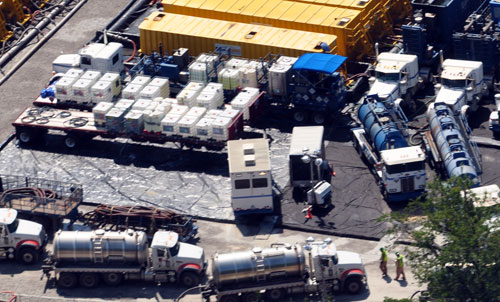
Below are photos of brine tankers and water tanker trucks involved with hauling water to frack jobs on Marcellus Shale, as well as hauling the produced water (flowback) from separation tanks (condensate tanks) to huge wastewater pits, POTW's (Public Owned Treatment Works aka sewage plants) and processing facilities.
 
These tanker trucks also drain the green condensate tanks you see at gas wells sites. While the green tanks are marked with hazardous placards, these trucks have no placards, being unmarked other than the standard "RESIDUAL WASTE" lettering.
 
This trucking aspect of horizontal gas drilling greatly increases the strain on water resources, drinking water purity, road wear and air quality issues from added diesel fumes.
  
  
No hazmat placards appear on any of these trucks like
the placards you see on the tanks they haul fluids from
 
  Hazmat markings on green condensate tanks (above)
Battery of green condensate tanks (below)


The gas industry estimates the amount of high-TDS wastewater needing disposal in Pennsylvania will increase from 9 million gallons per day in 2009 to 20 million gallons per day by 2011.

As Pennsylvania Implements New Wastewater Rules, Some State Waterways Still Face Problems


State police Maj. Harvey Cole Jr. said that in response to significant increases in truck traffic, the department had conducted 5,800 roadside inspections of industry trucks since January 2010 and found 13,000 driver and vehicle safety violations, including 2,800 serious enough to put the driver or truck out of service. In all, 42% of the inspections resulted in pulling drivers or vehicles out of service, he said. The national average for all truck inspections is 24%.

Pittsburgh Post-Gazette
June 22, 2011


Hit Counter


home     terms of use     contact
Copyright ©2009-2012    Marcellus-Shale.us    All rights reserved.