|
| |
FRACKING
|
|
Fracking is slang for hydraulic fracturing, and both
terms describe the process used to frack (or frac)
Marcellus Shale gas wells. To release methane from shale, high
pressure is used to crack the shale formation. While there are
alternatives to water for fracking gas wells (like nitrogen)
production companies prefer to use water since higher hydraulic pressures can
be created. |
|
|
Some reports indicate these pressures can reach
as high as 10,000
to 15,000 psi (pounds per square inch). Chemicals are added to the
water and sand for the 'slick water' hydraulic fracturing
commonly used on Marcellus wells. |
|
New Study Predicts Frack Fluids Can Migrate to Aquifers
Within Years
May 1, 2012 -
Scientists have theorized that
impermeable layers of rock would keep the fluid, which
contains benzene and other dangerous chemicals, safely
locked nearly a mile below water supplies. This view of
the earth's underground geology is a cornerstone of the
industry's argument that fracking poses minimal threats
to the environment.
But the study, using computer modeling,
concluded that natural faults and fractures in the
Marcellus, exacerbated by the effects of fracking
itself, could allow chemicals to reach the surface in as
little as "just a few years." "Simply put, [the rock
layers] are not impermeable," said the study's author,
Tom Myers, an independent hydrogeologist whose clients
include the federal government and environmental groups.
Story |
Below is a collection of
fracking photos which show the wide array of fracking
equipment that needs to be assembled on a Marcellus Shale
drilling pad to frac a well. During fracking
activities, truck traffic to a well site is extremely heavy.
|
 |
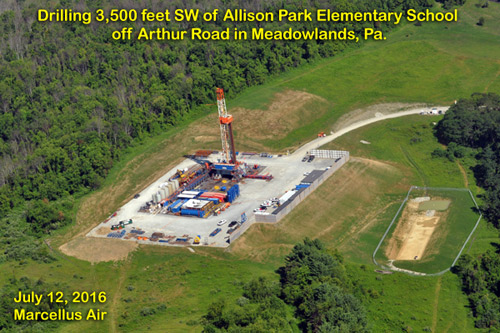
Fracking Marcellus Shale gas wells in S.W. Pennsylvania
|
 |
Tractor trailer used for carrying frac sand
|
 |
Aerial photo of fracking with fracture pumps
lined-up in rows on well pad
|
 |
Fracture pumps are used in series to produce the
10,000 to 15,000
psi used to crack the shale
|
|
Use of
Diesel Fuel in Fracking
Injection of
Hydraulic Fracturing Fluids Containing Diesel Fuel:
By Company (2005-2009)
|
Company |
Volume (gallons) |
|
Basic
Energy Services |
204,013 |
|
BJ
Services |
11,555,538 |
|
Complete |
4,625 |
|
Frac
Tech |
159,371 |
|
Halliburton |
7,207,216 |
|
Key
Energy Services |
1,641,213 |
|
RPC |
4,314,110 |
|
Sanjel |
3,641,270 |
|
Schlumberger |
443,689 |
|
Superior |
833,431 |
|
Trican |
92,537 |
|
Weatherford |
2,105,062 |
|
Total |
32,202,075 |
Injection of
Hydraulic Fracturing Fluids
Containing Diesel Fuel:
By State (2005-2009)
|
State |
Volume (gallons) |
|
State |
Volume (gallons) |
|
AK |
39,375 |
|
MS |
221,044 |
|
AL |
2,464 |
|
MT |
662,946 |
|
AR |
414,492 |
|
ND |
3,138,950 |
|
CA |
26,466 |
|
NM |
605,480 |
|
CO |
1,331,543 |
|
OK |
3,337,325 |
|
FL |
377 |
|
PA |
589 |
|
KS |
50,304 |
|
TX |
16,031,927 |
|
KY |
212 |
|
UT |
404,572 |
|
LA |
2,971,255 |
|
WY |
2,954,747 |
|
MI |
8,007 |
|
Total |
32,202,075 |
Source:
U.S. House of Representatives Committee on Energy &
Commerce - Democrats
Jan. 31, 2011
|
|
|
 |
Drilling industry truck on a Pa. interstate
|
 |
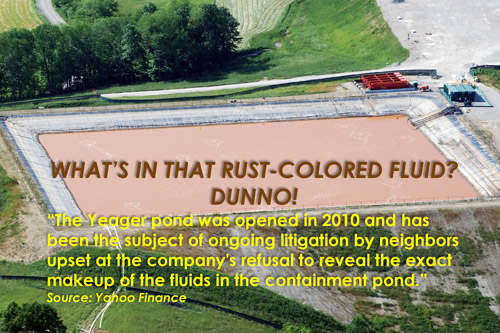
Fluid impoundment next to an active frac site
|
 |
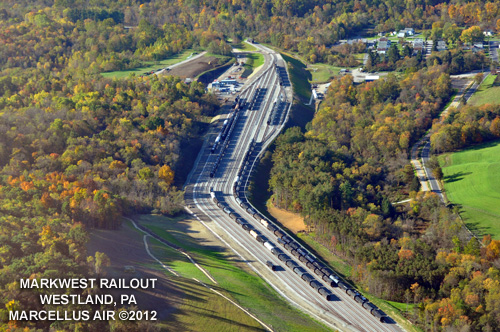
Four frac sand railcars next to storage towers
|
 |
Map of Fracked Counties in the US
Source: U.S. EPA
|
 |
Square, green frac tanks and red fracture pumps
lined-up in rows on a drilling pad
|
 |
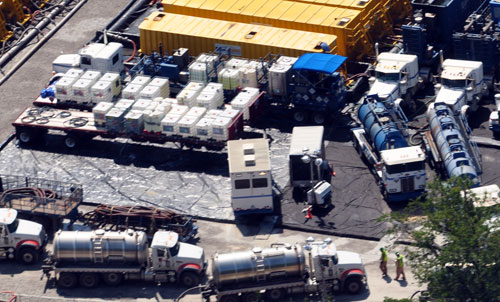
White plastic cube-shaped containers of
frac chemicals on tractor trailers
|
A LOOK AT FRAC
CHEMICALS USED
FOR
OHIO VALLEY LBC UNIT 8H OG WELL
Company: Range Resources
Fracture date: 4th Quarter 2011
True Vertical Depth: 6,409 feet
Total Water Volume: 2,603,404 gallons
Photos of site
SOME OF THE CHEMICALS
USED
Source of chemical list:
FracFocus
Chemical descriptions: Multiple sources |
| TRADE
NAME |
PURPOSE |
INGREDIENTS |
CHEMICAL ABSTRACT SERVICE NUMBER (CAS #) |
| 37% HCL |
Cleans
perforation |
HCL |
7647-01-0 |
| CI-100 |
Corrosion
Inhibitor |
Methanol |
67-56-1 |
| |
|
Methanol has
a high toxicity in humans. If ingested the median lethal
dose is typically 4 fl oz. |
| |
|
Propargyl
Alcohol |
107-19-7 |
| |
|
Propargyl
alcohol is a primary skin irritant and a severe eye
and mucous membrane irritant. It is toxic by ingestion,
inhalation, and skin adsorption. The oral LD50 for rats
is 70 mg/kg (WARNING LABEL – Moderate Toxicity). |
| MC B-8520 |
Antibacterial Agent |
4,4-Dimethyloxazolidine |
51200-87-4 |
| |
|
Dimethyloxazolidine has been placed in Toxicity
Category I for its effects as a severe eye irritant.
4,4-Dimethyloxazolidine is slightly to moderately
toxic to birds on an acute basis and slightly toxic on a
subacute basis. It demonstrates slight toxicity to both
cold and warm freshwater fish, and is slightly toxic to
freshwater invertebrates on an acute basis. |
| |
|
3,4,4-Trimethyloxazolodine |
75673-43-7 |
| |
|
2-Amino-2-methyl-1-propanol |
124-68-5 |
| |
|
AMP
(2-Amino-2-methyl-1-propanol) is a skin irritant,
severe eye irritant, and toxic by ingestion. Causes
severe irritation. Inhalation may be fatal as a result
of spasm, inflammation, and edema of laryns and bronchi,
chemical pneumonitis, and pulmonary edema. Symptoms of
exposure may include burning sensation, coughing,
wheezing, laryngitis, shortness of breath, headache,
nausea and vomiting. |
| |
|
Formaldehyde Amine |
56652-26-7 |
| MC B-8650 |
Antibacterial Agent |
Glutaraldehyde |
111-30-8 |
| |
|
The
following health effects have been reported in hospital
workers exposed to glutaraldehyde: Throat and
lung irritation; Asthma, asthma-like symptoms, and
breathing difficulty; Nose irritation, sneezing, and
wheezing; Nosebleed; Burning eyes and conjunctivitis;
Rash-contact and/or allergic dermatitis; Staining of the
hands (brownish or tan); Hives; Headaches and Nausea. |
| |
|
Methanol |
67-56-1 |
| |
|
Methanol
has a high toxicity in humans. If ingested the median
lethal dose is typically 4 fl oz. |
Chemicals in Natural Gas Operations
|
|
 |
|
A LOOK AT FRAC CHEMICALS USED
FOR
TRAX FARMS INC 3H OG WELL
Company: Chesapeake
Fracture date: June 27, 2011
True Vertical Depth: 7,229 feet
Total Water Volume: 6,896,946 gallons
Photos of site
|
SOME OF THE
CHEMICALS USED
Source of chemical list:
FracFocus
Chemical descriptions: Multiple sources |
| TRADE
NAME |
PURPOSE |
INGREDIENTS |
CHEMICAL ABSTRACT NUMBER (CAS #) |
| Acid,
Hydrochloric 15% |
Acid |
Hydrochloric Acid |
7647-01-0 |
| |
|
Concentrated
hydrochloric acid (fuming hydrochloric acid)
forms acidic mists. Both the mist and the solution have
a corrosive effect on human tissue, with the potential
to damage respiratory organs, eyes, skin, and
intestines. |
| WIC-641L |
Iron
Control Agent |
Citric
Acid |
77-92-9 |
| WAI-251LC |
Corrosion
Inhibitor |
Ethylene
Glycol |
107-21-1 |
| |
|
Ethylene
glycol has been shown to be toxic to humans and is
also toxic to domestic pets such as cats and dogs.
Ethylene glycol is a toxic, colorless, odorless, almost
nonvolatile liquid with a sweet taste and is
occasionally consumed by children and dogs for its
sweetness. Following ingestion the symptoms of poisoning
follow a 3 step progression starting with intoxication
and vomiting, before causing metabolic acidosis,
cardiovascular dysfunction, and finally acute kidney
failure. |
| |
|
Dimethyl
Formamide |
68-12-2 |
| |
|
Dimethylformamide (DMF) has been linked to cancer in
humans, and it is thought to cause birth defects. In
some sectors of industry women are banned from working
with DMF. |
| |
|
*Proprietary* |
*N/A* |
| |
|
Decanol |
112-30-1 |
| |
|
Decanol
causes a high irritability to skin and eyes, when
splashed into the eyes it can cause permanent damage.
Inhalation and ingestion can be harmful; it is harmful
in the environment. |
| |
|
Isopropanol (Isopropyl Alcohol, Propan-2-ol) |
67-63-0 |
| |
|
Octanol |
111-87-5 |
| |
|
2-Butoxyethanol (Ethylene Glycol Monobutyl Ether) |
111-76-2 |
| |
|
Moderate
respiratory exposure to 2-butoxyethanol often
results in irritation of mucous membranes of the eyes,
nose and throat. Heavy exposure via respiratory, dermal
or oral routes can lead to hypotension, metabolic
acidosis, hemolysis, pulmonary edema and coma. Acute
exposure to high levels of the glycol ethers in humans
results in narcosis, pulmonary edema, and severe liver
and kidney damage. Chronic exposure to the glycol ethers
in humans results in fatigue, lethargy, nausea,
anorexia, tremor, and anemia. 2-Butoxyethanol has come
under scrutiny in Canada. |
| EC6110A |
Anti-Bacterial Agent |
Glutaraldehyde |
111-30-8 |
| |
|
The
following health effects have been reported in hospital
workers exposed to glutaraldehyde: Throat and
lung irritation; Asthma, asthma-like symptoms, and
breathing difficulty; Nose irritation, sneezing, and
wheezing; Nosebleed; Burning eyes and conjunctivitis;
Rash-contact and/or allergic dermatitis; Staining of the
hands (brownish or tan); Hives; Headaches and Nausea. |
| |
|
Quaternary Ammonium Compounds |
N/A |
| |
|
Quaternary ammonium compounds can display a range of
health effects, amongst which are mild skin and
respiratory irritation up to severe caustic burns on
skin and gastro-intestinal lining (depending on
concentration), gastro-intestinal symptoms (e.g., nausea
and vomiting), coma, convulsions, hypotension and death. |
| |
|
Ethanol |
64-17-5 |
| EC6629 |
Scale
Inhibitor |
*No
hazardous components* |
*None* |
| WFR-61LA |
Friction
Reducer |
Petroleum
Distillate Hydrotreated Light |
64742-47-8 |
| |
|
Distillates (Petroleum), Hydrotreated Light can
cause dizziness, headache, drowsiness, nausea,
unconsciousness from inhalation; and cough, diarrhea,
sore throat, and vomiting from ingestion. Swallowing the
liquid may cause aspiration into the lungs with the risk
of chemical pneumonitis. NIOSH states that it is harmful
to aquatic organisms. The substance may cause effects on
the central nervous system. |
| |
|
Sodium
Chloride |
7647-14-5 |
| |
|
Alcohols
ethoxylated
C12-16 |
68551-12-2 |
| |
|
Quarternary Ammonium Chloride |
12125-02-9 |
| |
|
Quaternary ammonium compounds can display a range of
health effects, amongst which are mild skin and
respiratory irritation up to severe caustic burns on
skin and gastro-intestinal lining (depending on
concentration), gastro-intestinal symptoms (e.g., nausea
and vomiting), coma, convulsions, hypotension and death. |
| WGA-15L |
Gelling
Agent |
Petroleum
Distillate Hydrotreated Light |
64742-47-8 |
| |
|
Distillates (Petroleum), Hydrotreated Light can
cause dizziness, headache, drowsiness, nausea,
unconsciousness from inhalation; and cough, diarrhea,
sore throat, and vomiting from ingestion. Swallowing the
liquid may cause aspiration into the lungs with the risk
of chemical pneumonitis. NIOSH states that it is harmful
to aquatic organisms. The substance may cause effects on
the central nervous system. |
| |
|
*Proprietary* Polymer |
*N/A* |
| WBK-134 |
Breaker |
Ammonium
Persulfate |
7727-54-0 |
| |
|
Ammonium
Persulfate airborne dust may be irritating to eyes,
nose, lungs, throat and skin upon contact. Exposure to
high levels of dust may cause difficulty in breathing in
sensitive persons. This product has moderate oral
toxicity and sensitive persons may develop dermatitis
and asthma. |
Chemicals in Natural Gas Operations
|
|
 |
Hydrochloric Acid
Hazmat placard 1789
|
 |
'Sand Kings' at a frack site (video
tour)
|
 |
Fracking shale wells
Southwest of
Carmichaels, Pennsylvania
|
 |
|
 |
|
 |
Frac sand resembles sandbox sand, yet it is chosen for its
special qualities to act as a 'proppant' to hold open the
fractures in the shale so Marcellus gas can escape
|
 |
Rural fracking site
|
 |
White pipes bring fluids to the frac site,
frac sand trucks at top left of photo
|
 |
One of the pumps used in series to create
extreme shale cracking pressures
|
 |
Frac tanks lined-up on edge of drilling pad
|
 |
Pumps, fluid containers and the typical dust
that rises from frac sites
|
 |
Multiple gas wells being fracked
|
 |
Fluid trailers lined-up in a row
|
 |
What some of the "one-half of one percent"
actually looks like
|
|
Mum's the word!
10,000 times
in 20 months!
"Of 12,410
instances of hydraulic fracturing in Texas between April
2011 and early December 2012, companies used terms such
as “proprietary,” “secret” or “confidential” 10,120
times while reporting data on the FracFocus.org website,
according to data collected through early December by
the Houston-based Pivot Upstream Group and analyzed by
the San Antonio Express-News."
FuelFix.com blog 2-3-13 |
|
|
 |
Fracking in the panhandle of West Virginia
|
 |
White cubes on truck trailers hold frac chemicals
|
 |
|
| LINKS
Critics Find Gaps in State Laws to Disclose Hydrofracking Chemicals
New!
The FRAC
Act
Energy Policy Act of 2005 |
|
|
| |
|
 |
|