Our look at
NATURAL GAS PIPELINE CONSTRUCTION
|
Once the gas wells are drilled and the
natural gas begins to flow, it becomes necessary to deliver the gas
and gas liquids to market. Natural gas pipelines move gas to
compressor stations and wet gas processing facilities to separate
the natural gas from the natural gas liquids (NGL's).
|
|
|
Here we get a glimpse of natural gas pipeline construction over
Marcellus Shale. Photos of excavation equipment, gas pipe and
pipeline construction are featured, from recent photo tours of
Marcellus Shale natural gas well drilling areas in Pennsylvania and
West Virginia. Cross-country pipelines are seen travelling over
hills and through valleys of the rolling terrain. |
| |
|
PIPELINE
CONSTRUCTION PHOTOS |
|
 |
|
Installing gas pipeline in Washington County, Pa.
|
|
 |
|
Stream breached by
muddy May 2011 run-off.
Baker Station Road, Amwell Township, Pa |
|
 |
|
|
|
 |
|
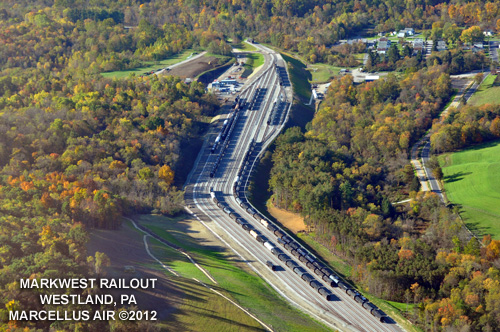
Pipeline construction between West Virginia and
Pennsylvania
connecting to the
MarkWest Plant in Houston, Pa.
|
|
 |
|
|
|
 |
|
Green protective coating on new gas pipe
|
|
 |
|
Gas pipe laid out and awaiting installation.
Welds at joints are X-Rayed.
|
|

|
|
 |
Future Marcellus pipeline cuts through a farm
field
in Washington County Pennsylvania
|
 |
Pipeline construction
|
 |
|
 |
Pipeline workers installing new pipeline
|
 |
|
|
Methane Is Popping Up All Over Boston
November 20, 2012 – NEW YORK TIMES by
Joanna M. Foster - Concern over water contamination from
fracking for natural gas aside, some argue that the
much-advertised climate advantage of natural gas may be
all but offset by the steady release of methane during
its long journey from the well to the 65 million
American households that depend on natural gas. Molecule
per molecule, methane has more than
20 times the
global warming potential
of carbon dioxide. Now researchers in Boston have given
skeptics of the at-least-natural-gas-is-better- than-
coal argument some additional ammunition.
In Boston and many other aging cities in
the Northeast, a maze of underground low-pressure
natural gas pipelines are riddled with leaks. The
research team discovered 3,356 leaks of methane whose
isotopic characteristics indicated that they originated
in fossil fuel rather than microbial sources. Some leaks
clocked in at more than 15 times the global background
methane level. According to the Energy Information
Administration, an average of $3.1 billion worth of
natural gas is lost or unaccounted for nationally each
year. Generally it is the consumer ratepayers, not the
producers, who pay the penalty for the lost gas.
|
|
|
 |
|
 |
|
 |
Gas pipeline company uses tracked vehicles for
rough terrain
|
 |
|
 |
E&S (erosion & sedimentation) roll crosses dirt
path
|
 |
Gas pipe cribbed up to allow access on all sides
of pipe
|
 |
|
New gas pipe going into
the ground is around $1 million to $1.5 million per
mile. In 1968, Congress began imposing federal
construction standards on new natural gas pipelines,
resulting in improvements to welds, coatings and
pipeline inspections. |
|
 |
|
 |
|
 |
Pipeline ditch being backfilled
|
 |
|
 |
"Pig launchers"
|
 |
|
 |
|
Pipeline regulation is handled by:
-
The Federal Energy Regulatory
Commission (FERC) regulate gas transportation rates, pipeline
capacity, pipeline siting and natural gas quality requirements.
-
The U.S. Department of
Transportation (DOT) Pipeline and Hazardous Materials Safety
Administration (PHMSA) provide regulation for the safe
transportation of natural gas through pipelines.
-
The U.S. Environmental
Protection Agency (EPA) and the state environmental protection
agencies provide regulations for protection of the environment
during the construction and operation of pipeline facilities.
-
The U.S. Occupational Safety
and Health Administration (OSHA) provides regulation for safe
working conditions.
-
The U.S.
Department of Interior Minerals Management Service (MMS)
provides regulation for offshore pipeline easement leases.
|
|
 |
More "Pig launchers"
|
 |
Stream crossing covered with timbers
|
 |
|
 |
|
 |
|
 |
|
 |
|
 |
Ditch for two gas pipelines
|
 |
Amwell Township Pennsylvania gas pipeline
|
 |
Installing gas pipeline on a steep slope
|
 |
|
 |
Gas pipeline installation
Before (above)
After (below) |
 |
|
 |
December 2011 - Another new gas pipeline between
Caldwell Rd. and Agape Rd. for Bible Camp gas
|
 |
Gathering pipeline across from Ohio Valley
Lutheran Bible
Camp on Agape Road in Hickory - December 2011
|
 |
Pipe yard along the Monongahela River
|
 |
Pipeline installations accelerated in
Washington County in 2013
|
 |
| |
|
LINKS
Pipeline maps
New!
Marcellus gathering pipelines
How safe are America’s 2.5 million miles of pipelines? |
| |
|
|
| |
|
 |