MARCELLUS
SITE MAP
Home
Terms of use
Contact us
Links
DRILLING
NEWS
Blogs
Shale Gas News
Updated!
Public Meetings
MARCELLUS AIR
PHOTOS
Aerial photographs of Marcellus Shale activities
Marcellus Shale drilling seen from the air
Ohio Marcellus Shale
Marcellus Shale pics
New photos!
MARCELLUS
LEGISLATION
Pa. Act 13
Drilling legislation
Engaged citizens
The FRAC Act
Halliburton loophole
SHALE WELL
MAPS
New York map
Ohio map
Pennsylvania map
West Virginia map
POLITICAL
CONTRIBUTIONS
2009-2010
2007-2008
2004-2006
MARCELLUS
RIVERS
DRBC
ORSANCO
SRBC
MARCELLUS
WATER
ALL HAIL
Marcellus Shale
Beaver Run Reservoir
Blake Run Falls
Carol Baker Impoundment
Creeks & waterways
Cross Creek Lake
Dunkard Creek
Impoundments
Monongahela River
Piping water
Wanted: Water
Water Management Plans for SW Pa.
WV Water Project
DRILLING WASTE & WASTEWATER
Brine truck photos
Clairton Municipal
New!
Disposal wells
Drilling wastewater
McKeesport Municipal
WASTE
FACILITIES
Mid-2009 to Mid-2010
Late-2010
Early-2011
Late-2011
Early-2012
Late-2012
MARCELLUS
ACCIDENTS
Atlas Frac Pit Fire
Gas well fires
Seeps, leaks, spills
Violations Tip Line
DRILLING
ISSUES
Intro to Marcellus
Air quality
Before you lease
Christmas Carols
Diesel idling - Act 124
Fracking near Schools
FrackNation movie
Forest fragmentation
Gas Drilling Wastewater
GASLAND movie
Jobs
Lessons learned
Updated!
Marcellus documents
Pets and wastewater
Promised Land Movie
Radioactive shale
Road damage
Sick cattle
Talking points
Trinity South
Triple Divide movie
Trouble in Truthland
Truck traffic
Utica Shale
FIRSTHAND
EXPERIENCES
Nancy Bevins
June Chappel
Jaime Frederick
Carol French
Terry Greenwood
Ron Gulla
Stephanie Hallowich
Pam Judy
Kimberlie McEvoy
Tim Ruggiero
Darrell Smitsky
Crystal Stroud
Calvin Tillman
Beth Voyles
Updated!
YouTube
GAS FACILITIES & EQUIPMENT
Air testing
Compressor stations
Frac truck photos
Fracking
Gas flares
Gas pipelines
Gas shale plays
Gathering pipelines
Houston Pa. Gas Processing Plant
Lowry Compressor Station
Majorsville Gas Plant
Marcellus FRAC
Marcellus pipeline
Pennsylvania DEP
Photos of gas wells
Propane trains
Restored well sites
Seismic testing
Terminology glossary
Tupta Day Compressor Station
Welling Compressor Station
MARCELLUS
SHALE WELLS
Natural Gas Prices
Marcellus Gas Production
Now Drilling
Avolio Unit
Baker, Carol Unit
Bedillion-Day Unit
Bednarski Unit
Best Production Pad
Bigley Unit
Black, William Unit
Chappel Unit
Chiarelli Pad
Costanzo Unit
Cowden 1H-2H
Cowden 3H-6H
Cross Creek Park
Day Unit
Drugmand Unit
Engel Unit
Foster Unit
Franklin Lakeview Estates
Godwin Unit
Goettel Unit
Harbison Unit
Hoskins Unit
Kearns Unit
LBROS Unit
Lowry Unit
Miller, John Unit
Miller, Lois Unit
Ohio Valley LBC
Renz Well
Rodenski Unit
Rush, John Unit
Sierzega Unit
Trax Farms
Troyer/Space Mgmt
Ward Unit
Weimer Unit
West, Eleanor
Worstell Unit
West Virginia wells
 

Our look at
ROAD DAMAGE
from heavy truck traffic

Heavy truck traffic begins as soon as a Marcellus gas well site is developed. First, heavy excavation equipment must be hauled in to grade the access road and level a multi-acre drilling pad. Then trucks haul in hundreds of tons of crushed stone for final construction of the road and drilling pad.
  
Multiple tractor-trailer loads are then required to haul in the various parts of the drill rig, while later hauling away these same parts from the gas well site. The largest volume of truck traffic begins with the hydraulic fracturing of gas wells, especially if more than one well is fracked at the same time.
  
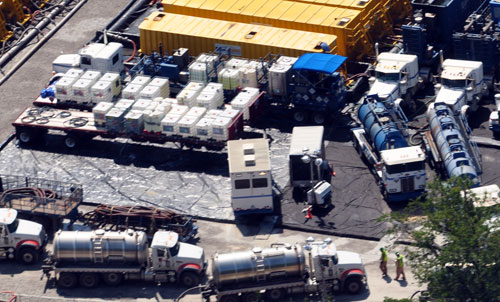
Frac pumps, holding tanks, tanker trucks and a wide variety of support trucks and equipment eventually crowd the frac site. During fracking, tractor-trailer loads of sand are continually delivered to the Marcellus well site.
   

Studies indicate it can take anywhere from 400 to 1,300 truck trips to complete one gas well. There are seven gas wells on this site.

Truck traffic will continue as the condensate tanks are periodically drained and the gas wells are maintained. This amount of heavy truck traffic damages roads and also contributes greatly to the creation of ground level ozone.

  
Once the frac is complete, scores of trucks from service companies arrive to complete the gas wells. Finished wells require regular visits from well tenders and other service equipment. One Denton, Texas study determined that for all three phases of a gas well -- drilling, fracing, and maintenance -- approximately 592 one-way truck trips were required per well. Some individual trucks weighed as much as 80,000 to 100,000 lbs when fully loaded.
    
These projects resemble industrial operations, so state, county and local roads take a real pounding. Municipalities are well advised to Bond their roads prior to drilling activities, so the roads can be repaved once these major activities are completed. Below are photos of secondary blacktop roads on Marcellus Shale that have been pummeled by heavy truck traffic to a rural drilling site.


Blacktop road has been pulverized by heavy traffic


Damaged Bridge


Gravel road to mud road


30 to 40 ton tanker truck when fully loaded


Oversized loads must traverse country roads


Frac sand tanker truck


Heavy equipment on a well pad


Partial patch of damaged road


Patchwork quilt of road patches


Large trucks used to create pressure for fracking


Country road with limited width


LPG tanker on a country highway
  
  
Rutting from wide turns


Hit Counter


home     terms of use     contact
Copyright ©2009-2013    Marcellus-Shale.us    All rights reserved.